
Choosing a SASE vendor usually comes down to a handful of names, and Forcepoint keeps showing up on that shortlist — especially for organizations already leaning on its data protection heritage. But “Forcepoint SASE” isn’t a single product name you’ll find on their pricing page; it’s the architecture Forcepoint delivers through its unified platform, Forcepoint ONE. This guide breaks down what that actually means, what you get, how it compares to the bigger names in the market, and who it genuinely fits.
What Is Forcepoint SASE?
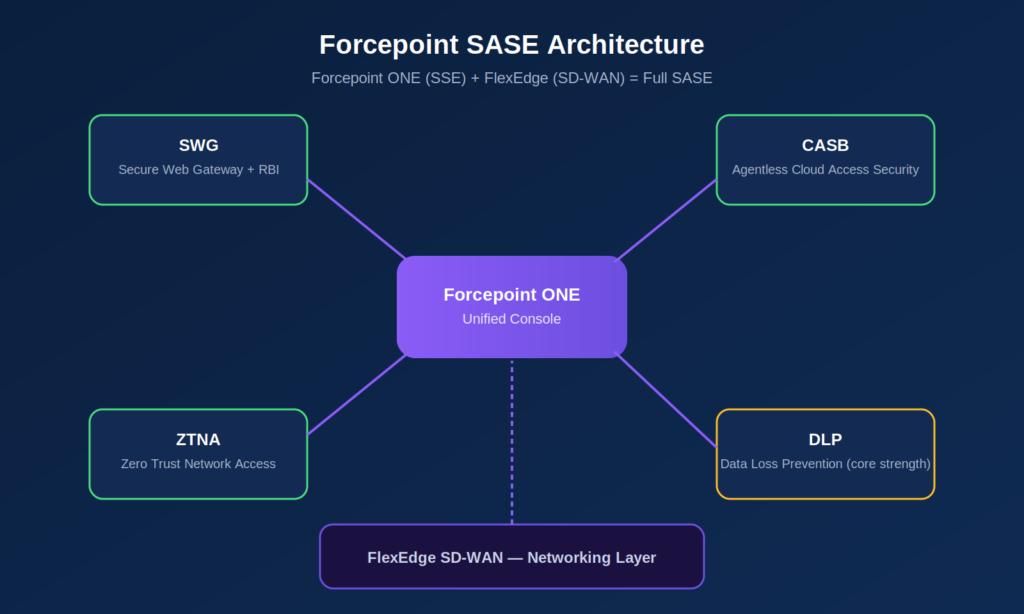
SASE (Secure Access Service Edge) combines networking and security into a single, cloud-delivered service — replacing the older model of routing all traffic through a physical data center for inspection. Forcepoint’s SASE approach is delivered through Forcepoint ONE, an all-in-one Security Service Edge (SSE) platform that also connects to Forcepoint’s SD-WAN offering, FlexEdge, to complete the full SASE picture.
“This shift also puts more pressure on the underlying infrastructure handling that traffic — see our server performance management guide for how to keep those systems fast and reliable.”
Rather than positioning itself as a pure networking-first vendor, Forcepoint’s roots are in data protection — and that shows in how the platform is built. The company is recognized as a cybersecurity vendor by analyst firms including Gartner and Forrester, with particular strength in data loss prevention (DLP) and insider risk.
Forcepoint ONE at a Glance
- Agentless CASB (Cloud Access Security Broker)
- ZTNA (Zero Trust Network Access) for private applications
- Secure Web Gateway (SWG) with integrated remote browser isolation (RBI)
- Cloud and SaaS Security Posture Management (CSPM/SSPM) with optional auto-remediation
- One console, one policy set, one endpoint agent across all modules
- Reported 99.99% verified uptime since 2015
- More than 300 points of presence (PoPs) worldwide
Core Features Explained
Secure Web Gateway (SWG)
Forcepoint’s SWG inspects and filters web traffic, blocking malicious sites and enforcing acceptable-use policies. What differentiates it from a basic filter is the integrated remote browser isolation with content disarm and reconstruction (CDR) — risky web content is rendered in an isolated environment rather than reaching the user’s device directly.
Cloud Access Security Broker (CASB)
The CASB component is agentless, meaning it doesn’t require installing software on every device to monitor and control how users interact with cloud and SaaS applications. This matters for organizations with contractors, BYOD policies, or unmanaged devices in the mix.
Zero Trust Network Access (ZTNA)
Instead of a traditional VPN granting broad network access, ZTNA grants access to specific private applications based on identity and context — reducing the attack surface if a credential is compromised.
Data Loss Prevention (DLP)
This is widely considered Forcepoint’s strongest differentiator. The DLP engine tracks how sensitive data is used and moved, not just where it’s stored, which is particularly valuable for regulated industries handling healthcare records, financial data, or intellectual property.
Real-World Fit: Who Uses Forcepoint SASE
Forcepoint’s platform shows up most often in healthcare, financial services, and manufacturing — sectors where compliance requirements (HIPAA, PCI, GDPR) make its data-centric approach to security a natural fit. It’s also commonly deployed by government and public sector organizations, an area where Forcepoint has a long-standing presence.
Forcepoint SASE vs. the Rest of the Market
Analysts generally place SASE vendors into two tiers. The enterprise tier — Zscaler, Palo Alto Networks Prisma SASE, Netskope, Cato Networks, and Cisco Secure Access — tends to lead on either inspection depth or SD-WAN performance. The mid-market tier, where Forcepoint sits alongside Fortinet, Cloudflare, and Check Point, offers a faster, more accessible entry point, often built around a specific strength — in Forcepoint’s case, that’s DLP.
Forcepoint ONE — Pros and Cons
| Pros | Cons |
|---|---|
| Strong, mature DLP and insider risk capabilities | Integration with existing infrastructure can be complex |
| Unified console across SWG, CASB, ZTNA, and posture management | Some users report delays in cloud-based policy enforcement |
| High verified uptime and large global PoP network | Setup and pricing structure is more intricate than some competitors |
| Well-suited to regulated industries (healthcare, finance) | Less networking-native than SD-WAN-first vendors like Cato or Versa |
How It Compares to Specific Alternatives
- Forcepoint ONE vs. Netskope — Netskope is generally viewed as having a more straightforward setup process, while Forcepoint’s strength is deeper data classification.
- Forcepoint ONE vs. Cisco Secure Access — Forcepoint tends to come in at a lower initial setup cost, while Cisco offers broader ecosystem integration for existing Cisco shops.
- Forcepoint ONE vs. Cato Networks — Cato leads on SD-WAN-native performance and simpler deployment; Forcepoint leads on data protection depth.
Pricing: What to Expect
Forcepoint doesn’t publish public SASE/SSE pricing — like most enterprise security vendors, quotes are based on user count, modules selected, and contract length. Buyer reports describe the setup process and cost structure as more variable and complex than some competitors, so it’s worth requesting a detailed quote broken down by module (SWG, CASB, ZTNA, DLP) rather than a single bundled number, especially if you only need part of the platform.
Getting Started: Practical Steps
- Identify your primary driver — if DLP and compliance are the main concern, Forcepoint is a strong candidate; if SD-WAN performance is the priority, compare against Cato or Versa first
- Request a scoped demo focused on your actual use case (e.g., healthcare data protection) rather than a generic platform walkthrough
- Ask for module-level pricing, not just a bundled quote
- Check integration compatibility with your existing identity provider (IdP) and infrastructure before committing
- Pilot with a single department or use case before a full rollout, given the reported complexity of initial setup
FAQs
Is Forcepoint SASE the same as Forcepoint ONE? Forcepoint ONE is the platform name; “Forcepoint SASE” describes the architecture it delivers, especially when paired with Forcepoint’s FlexEdge SD-WAN for full SASE (network plus security) coverage.
What makes Forcepoint different from Zscaler or Netskope? Forcepoint’s core strength is data loss prevention and insider risk, rooted in its data security heritage, whereas Zscaler and Netskope are generally viewed as leading on inspection scale and cloud-native networking performance respectively.
Is Forcepoint SASE good for small businesses? It’s more commonly deployed by mid-size and enterprise organizations, particularly in regulated industries. Smaller businesses without complex compliance needs may find simpler, less feature-dense SASE or SSE tools a better fit for budget and setup effort.
Does Forcepoint SASE include SD-WAN? Full SASE coverage requires pairing Forcepoint ONE (the SSE/security layer) with Forcepoint FlexEdge (the SD-WAN/networking layer) — they aren’t the same single product.
How does Forcepoint handle compliance requirements like HIPAA? Forcepoint’s data-centric DLP approach is frequently highlighted in healthcare and financial services deployments, where tracking how sensitive data is used and moved is central to meeting HIPAA and similar regulatory requirements.
Final Thoughts
Forcepoint SASE earns its place on shortlists for one clear reason: data protection depth. If your organization’s biggest risk is sensitive data leaving the building — healthcare records, financial data, intellectual property — Forcepoint ONE paired with FlexEdge is a genuinely strong, purpose-built option. If your priority is SD-WAN-native performance or the simplest possible setup, it’s worth comparing against Cato Networks or Netskope before deciding. Either way, request module-level pricing and a scoped pilot before committing — the platform’s flexibility is real, but so is its setup complexity.