

Every SOC eventually runs into the same architectural question: does the network tell you enough, or do you need to see what’s happening on the endpoint itself? Intrusion Detection Systems were built to answer the first question. Endpoint Detection and Response was built to answer the second. Most breaches today don’t respect that boundary — an attacker moves from a phishing email to a compromised laptop to lateral movement across the network in a matter of minutes, and a tool that only sees one side of that chain will miss half the story.
This guide breaks down what IDS and EDR actually do, where each one falls short on its own, how they compare side by side, and how CISOs and SOC managers are combining them — often as part of a broader EDR vs IDS vs IPS and XDR strategy — into a coherent detection architecture for 2026.
What Is an Intrusion Detection System (IDS)?
An Intrusion Detection System monitors traffic or system activity for signs of malicious behavior and generates alerts when it finds something suspicious. IDS has been a foundational layer of network security for decades, and it still plays a role in most SOC architectures today — but understanding its scope is essential before deciding where it fits.
NIDS vs HIDS
IDS deployments fall into two broad categories:
- Network Intrusion Detection Systems (NIDS) sit at strategic points on the network — typically at a perimeter or a key internal segment — and inspect traffic flowing through that point. NIDS is well suited to spotting scanning activity, known exploit traffic, and command-and-control communication crossing the wire.
- Host Intrusion Detection Systems (HIDS) run on individual servers or workstations and monitor local activity: file integrity changes, log entries, configuration modifications. HIDS gives visibility that NIDS can’t, but it’s historically been lighter-weight and less behaviorally sophisticated than modern endpoint tools.
The HIDS vs NIDS distinction matters operationally: NIDS covers what crosses the network, HIDS covers what happens on a single machine, and neither one, by itself, covers both.
Signature-Based vs Anomaly-Based Detection
IDS platforms typically detect threats using one of two methods:
- Signature-based detection compares traffic or activity against a database of known attack patterns. It’s fast and low on false positives for known threats, but it’s blind to anything that doesn’t match an existing signature — including zero-days and novel attack techniques.
- Anomaly-based detection builds a baseline of “normal” behavior and flags deviations from it. This can catch unknown threats, but it tends to generate more false positives and requires ongoing tuning to stay accurate.
The Core Limitation: Alert-Only Nature
The defining constraint of traditional IDS is right there in the name — it’s a detection system, not a response system. When an IDS spots something suspicious, it raises an alert and stops. It doesn’t isolate the host, kill the process, or roll back the change. Someone — a SOC analyst, an automated playbook via a SIEM or SOAR — has to take that alert and act on it. In a fast-moving intrusion, that gap between detection and containment can be the difference between an incident and a breach.
What Is Endpoint Detection and Response (EDR)?
Endpoint Detection and Response takes the opposite starting point: instead of watching the network for suspicious traffic, it watches the endpoint itself — continuously, in depth, and with the ability to act.
Continuous Monitoring and Telemetry
EDR agents run directly on endpoints — laptops, servers, workstations — and continuously collect granular telemetry: process creation, registry changes, network connections initiated by the host, file writes, memory activity, and more. This isn’t a periodic scan; it’s an ongoing stream of data that gets correlated centrally, giving analysts a detailed timeline of exactly what happened on a given machine before, during, and after an event.
AI and Behavioral Analysis
Modern EDR platforms lean heavily on behavioral analysis and machine learning rather than static signatures alone. Instead of asking “does this match a known malware hash,” EDR asks “does this sequence of actions look like an attack pattern” — a legitimate binary suddenly spawning a shell, an Office document launching PowerShell, unusual privilege escalation. Many platforms map these behaviors directly against the MITRE ATT&CK framework, giving analysts a shared vocabulary for what technique an attacker is actually using. This behavioral approach is what allows EDR to catch fileless malware and living-off-the-land techniques that never trigger a signature match — the same category of fast-evolving tradecraft behind the rise of AI-driven cyberattacks.
Active Containment
This is the defining difference from IDS: EDR doesn’t just alert, it acts. When it identifies a credible threat, EDR can isolate the endpoint from the network, kill the malicious process, quarantine the file, and roll back changes — automatically or with one click from an analyst. That built-in remediation capability is why EDR has become the anchor of modern threat remediation workflows rather than just another alert source feeding the SIEM.
EDR vs IDS – Side-by-Side Comparison Table
| Dimension | IDS | EDR |
|---|---|---|
| Data sources | Network packets, traffic flow, host logs (HIDS) | Process, file, registry, memory, and network telemetry from the endpoint agent |
| Location | Network perimeter/segments (NIDS) or individual hosts (HIDS) | Directly on the endpoint (laptop, server, workstation) |
| Action/remediation | Alert only — no automated response | Automated containment: isolate host, kill process, quarantine file, rollback |
| Scope of visibility | Traffic crossing the monitored point; limited insight into encrypted or off-network activity | Deep visibility into what happens on the device, including offline or encrypted-traffic activity |
| Deployment complexity | Moderate — requires network tapping/span ports or host agent installation and tuning | Moderate to high — requires agent rollout across all endpoints and ongoing tuning of behavioral models |
| Cost | Generally lower licensing cost; higher analyst time cost due to alert-only nature | Higher licensing cost; lower analyst time cost due to automated response and richer context |
Key Differences Breakdown
Data Depth
IDS sees what crosses a wire or what’s logged locally at a surface level; EDR sees what actually happens inside a process on the machine. If an attacker uses an encrypted channel or lives entirely within a single host’s memory, a network-based IDS may never see meaningful signal — while an EDR agent sitting on that host observes the process tree, memory injection, and file activity directly. This difference in data depth is the main reason EDR has become the primary investigative tool during incident response: it reconstructs a far more complete attack timeline than network telemetry alone.
Threat Response
The response gap is arguably the most consequential difference between the two categories. An IDS alert still requires a human or a separate automation layer to act — pulling in a SOAR platform, paging an analyst, manually isolating a host. EDR collapses that gap by embedding response directly into the detection layer. In a ransomware scenario, the seconds saved by automated isolation can be the difference between one infected endpoint and an entire encrypted network share.
Network Blind Spots vs Endpoint Blind Spots
Neither tool is complete on its own, and it’s important to be honest about where each one fails. IDS has a network blind spot: it can’t see activity that never touches the monitored segment, and encrypted traffic limits what NIDS can inspect without decryption infrastructure. EDR has an endpoint blind spot: it can’t see network-level reconnaissance, lateral movement between systems it isn’t deployed on, or unmanaged devices — IoT hardware, contractor laptops, shadow IT — that never got an agent installed. A mature SOC architecture accounts for both blind spots rather than assuming either tool covers the full environment.
Does EDR Replace IDS?
Not entirely — but the role of standalone IDS is shrinking as EDR and, increasingly, XDR (Extended Detection and Response) absorb more of its function. XDR platforms correlate endpoint, network, cloud, and identity telemetry into a single detection and response layer, effectively pulling IDS-style network visibility into the same pane of glass as EDR’s endpoint data.
That said, legacy IDS isn’t disappearing so much as evolving and narrowing its role. NIDS remains valuable for:
- Monitoring unmanaged or unmanageable devices where an EDR agent can’t be installed (OT/ICS equipment, IoT, legacy systems)
- Providing an independent detection layer that doesn’t depend on endpoint agent integrity — useful if an attacker manages to disable or blind an EDR agent
- Meeting specific compliance requirements that mandate network-level monitoring
For most organizations, the realistic 2026 architecture isn’t “EDR instead of IDS” — it’s EDR as the primary endpoint and response layer, with IDS/NIDS functionality folded into a broader XDR or SIEM correlation strategy rather than run as an isolated, alert-only silo.
Real-World Implementation Scenarios
When to lean on IDS: Environments with a high proportion of unmanaged or non-standard devices — OT environments, medical devices, IoT fleets — where installing an EDR agent isn’t feasible. IDS is also useful as a compliance-driven network monitoring layer and as an independent check that doesn’t rely on endpoint agents staying healthy.
When to lean on EDR: Any environment where managed endpoints are the primary attack surface — which, for most modern organizations, is nearly everywhere. EDR should be the default for laptops, servers, and workstations, particularly where fast automated containment materially reduces incident impact.
How to combine them in a Zero Trust framework: Zero Trust assumes no implicit trust between network segments or devices, which means visibility has to exist at every layer, not just one. In practice, that looks like:
- EDR agents on every managed endpoint, feeding behavioral telemetry into a central detection platform
- NIDS or network sensors covering segments where EDR agents can’t be deployed, plus east-west traffic monitoring to catch lateral movement between segments
- Identity and access telemetry correlated alongside both, since Zero Trust treats identity as a primary control plane — starting with fundamentals like multi-factor authentication on every account that touches sensitive systems
- A SIEM or XDR layer that ties endpoint, network, and identity signals together into a single investigation view, rather than leaving analysts to manually cross-reference separate consoles
- Network access controls such as SASE to enforce policy-based segmentation between users, devices, and cloud services, reducing what an attacker can reach even after an initial compromise
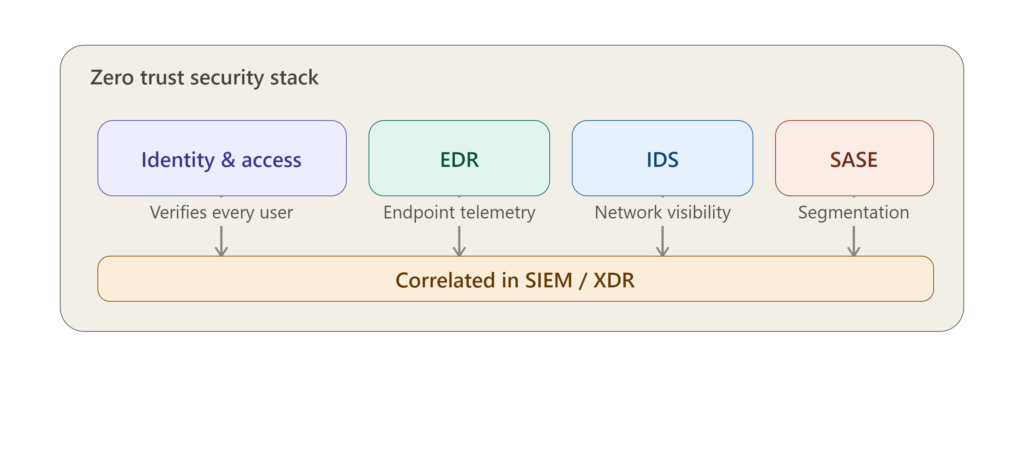
This layered approach reflects how modern SOC architecture is actually built: not a single tool making the call, but overlapping visibility that closes the blind spots each individual layer has on its own.
Conclusion & Actionable Checklist
IDS and EDR answer different questions — what’s crossing the network versus what’s happening on the device — and a mature security program needs both perspectives, weighted according to its own environment. The organizations getting this right in 2026 aren’t choosing one over the other; they’re deciding where each layer earns its place and connecting them through XDR or SIEM correlation so no single blind spot goes unmonitored.
Use this checklist when evaluating tools for your environment:
- Map your asset landscape — quantify how many devices in your environment can and cannot support an EDR agent (OT, IoT, legacy systems, contractor devices).
- Assess your current response gap — measure how long it currently takes from alert to containment, and identify how much of that time automated EDR response could eliminate.
- Audit network blind spots — confirm whether your existing NIDS/HIDS coverage still has value for unmanaged segments or as an independent detection layer.
- Evaluate correlation capability — check whether your SIEM or XDR platform can actually ingest and correlate both endpoint and network telemetry, not just collect it in separate silos.
- Pilot before full rollout — test EDR agent performance and false-positive rates on a representative subset of endpoints before committing to organization-wide deployment.
Working through this checklist gives SOC managers and CISOs a defensible, evidence-based path to the right mix of IDS, EDR, and XDR for their specific environment — rather than a default choice driven by vendor marketing alone.