
Privacy Enhancing Computation: How Businesses Are Unlocking Data Without Exposing It
Every business wants to use more data — but every new dataset also brings more risk. Regulators are tightening rules, customers are more aware of how their information is used, and a single breach can cost millions in fines and trust. This tension between “use the data” and “protect the data” has pushed a once-niche field into the mainstream: privacy enhancing computation .
In this article, you’ll learn what privacy enhancing computation actually means, the core technologies behind it, how companies across finance, healthcare, and advertising are already putting it to work, and where the field is headed next.
What Is Privacy Enhancing Computation?
Privacy enhancing computation (sometimes shortened to PEC) refers to a set of technologies that let organizations analyze, share, or process data while keeping the underlying information hidden or protected. Instead of choosing between “share the raw data” and “don’t use the data at all,” privacy enhancing computation offers a third option: extract useful insights while the sensitive details stay encrypted, anonymized, or otherwise inaccessible.
This idea sits inside a broader category known as privacy-enhancing technologies (PETs) , which includes everything from anonymization tools to cryptographic protocols. What makes privacy enhancing computation distinct is its focus on computation — actually running calculations, machine learning models, or analytics on protected data, not just storing or transmitting it securely.
Gartner has flagged this space as one of the top strategic technology trends for data-driven organizations, largely because it solves a problem that traditional security tools can’t: enabling collaboration and analysis across organizational or jurisdictional boundaries without exposing raw data.
Key Techniques Behind Privacy Enhancing Computation
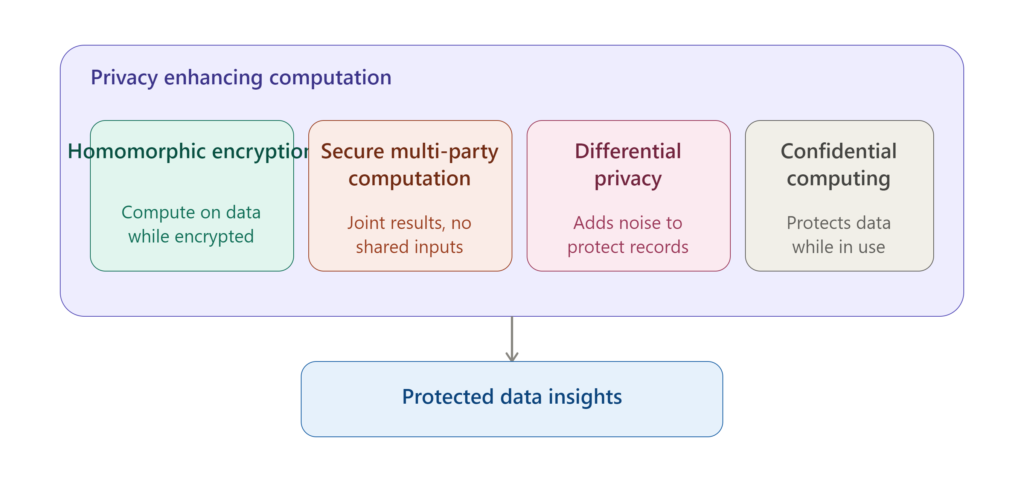
Privacy enhancing computation isn’t a single tool — it’s an umbrella covering several distinct approaches, each suited to different problems.
Homomorphic Encryption
Homomorphic encryption allows computations to be performed directly on encrypted data, producing an encrypted result that, when decrypted, matches the result of the same operations on the original plaintext. In practice, this means a cloud provider or third party can run calculations for you without ever seeing your actual data. It’s powerful, but historically has been computationally expensive — though recent hardware and algorithmic improvements are closing that gap.
Secure Multi-Party Computation
Secure multi-party computation (often called MPC) enables two or more parties to jointly compute a result based on their combined data — without any party revealing their individual inputs to the others. This is especially useful when competitors or partners need to collaborate on an analysis (like fraud detection across banks) but can’t legally or competitively share raw customer data with each other.
Differential Privacy
Differential privacy takes a different approach: it adds carefully calibrated statistical “noise” to a dataset or query result so that no individual record can be identified, while the overall patterns and trends remain accurate. It’s widely used for publishing aggregate statistics — for example, census data or app usage analytics — where the goal is population-level insight, not individual-level exposure.
Confidential Computing
Confidential computing protects data while it’s actively being processed (in use), not just when it’s stored or in transit. It relies on hardware-based “trusted execution environments” — secure enclaves within a processor — where data is decrypted only inside an isolated, protected space that even the cloud provider or operating system can’t access.
Federated Learning
Federated learning trains machine learning models across multiple devices or servers holding local data samples, without that data ever leaving its original location. Only model updates (not raw data) are shared and aggregated centrally. This is how technologies like predictive keyboards can improve without your typing history ever leaving your phone.
Real-World Use Cases Across Industries
Privacy enhancing computation isn’t theoretical — it’s already solving real business problems.
| Industry Sector | Primary Use Cases & Operational Objectives |
| Finance | Multi-Bank Anti-Money Laundering (AML): Banks correlate encrypted transaction data via SMPC to pinpoint money laundering rings without exposing confidential customer accounts to rivals. |
| Healthcare | Cross-Border Clinical Trials: Global research institutions run joint federated learning protocols across hospital networks to build diagnostic models without violating international patient data transfer laws. |
| Advertising | Privacy-Safe Attribution & Clean Rooms: Brands and publishers run clean-room attribution models over combined encrypted data sets to evaluate campaign ROI without sharing PII. |
| Retail & CPG | Joint Supply Chain Analytics: Retailers and consumer goods brands run confidential joint analytics on sales velocity and demand forecasting without disclosing supplier pricing models. |
Strategic Advantages & Implementation Challenges
Primary Business Advantages
- Safe Data Monetization: Safely collaborate on proprietary data assets through clean rooms without risking intellectual property leakages.
- Streamlined Regulatory Compliance: Align with strict privacy mandates (GDPR, CCPA, HIPAA) through verifiable privacy-by-design architectures.
- Reduced Infrastructure Risk: Run workloads confidently on public cloud platforms knowing sensitive data remains isolated from cloud host access or hardware-level subpoenas.
Operational Challenges
- Computational Overhead: Mathematical frameworks like Homomorphic Encryption introduce processing latency compared to unencrypted operations.
- Engineering Complexity: Implementing non-standard cryptographic APIs often requires specialized development skills and infrastructure updates.
- Utility Calibration: Setting parameters in differential privacy requires careful tuning to balance strict data privacy against analytical precision.
Future Trajectory & Adoption Roadmap
Analysis published by Gartner highlights how privacy-preserving mechanisms are transforming core infrastructure, predicting that over 75% of computational workloads in untrusted infrastructure will utilize confidential computing and PET frameworks to secure data in use. Coverage in publications like MIT Technology Review similarly emphasizes the role of these technologies in securing modern artificial intelligence systems.
Key operational trends driving cloud infrastructure security trends include:
- Multi-PET Hybrids: Combining hardware enclaves with differential privacy to maximize processing speed while maintaining strict privacy bounds.
- Generative AI Defense: Using confidential computing to protect proprietary AI model weights and prevent private enterprise prompts from leaking during model inference.
- Turnkey Cloud Integration: Cloud providers are increasingly embedding confidential hardware options directly into standard virtual machines, making enterprise deployment seamless.
As threat actors utilize machine-speed tools, integrating privacy enhancing computation into core analytics pipelines is becoming vital for defending against AI-driven cyberattacks without exposing sensitive telemetry data.
Next Steps for Technology Leaders
To integrate privacy enhancing computation into your organization:
- Identify Vulnerable Workloads: Audit where high-sensitivity data must be unencrypted in memory within multi-tenant cloud environments.
- Leverage Hardware Enclaves First: Implement confidential computing instances as an initial step, as they require minimal code modifications compared to pure cryptographic PETs.
- Establish Cross-Functional Governance: Partner IT security teams with legal and compliance departments to map specific PET choices directly to regulatory standards.
Adopting privacy enhancing computation transforms data privacy from a defensive compliance cost into an operational advantage—enabling safe data collaboration that was previously impossible.
Conclusion
Privacy enhancing computation gives businesses a genuine third path between “expose the data” and “don’t use it at all.” Whether through homomorphic encryption, secure multi-party computation, differential privacy, confidential computing, or federated learning, organizations now have practical tools to extract value from sensitive data while keeping it protected. As regulations tightens and data collaboration becomes more valuable, understanding — and eventually adopting — these technologies will matter for any business serious about data-driven growth.
Want to stay ahead of the curve on data security and digital transformation? Explore more insights on trendlior.com, or subscribe to get the latest ICT and digital marketing trends delivered straight to your inbox.